If you are thinking about building on Jost Van Dyke, the view is only part of the story. On an island known for steep terrain, coastal exposure, and a laid-back lifestyle, the smartest first step is not sketching the house. It is understanding the land, the approvals, and the practical limits that can shape your budget and timeline. This guide walks you through the due diligence essentials so you can plan with more confidence. Let’s dive in.
Start With the Site
Jost Van Dyke is the smallest of the four main British Virgin Islands, and it is described by the government as volcanic and mountainous. Majohnny Hill reaches 321 meters, and Great Harbour is the main port of entry. For you as a buyer or builder, that means the land itself can have a major effect on design, access, and cost.
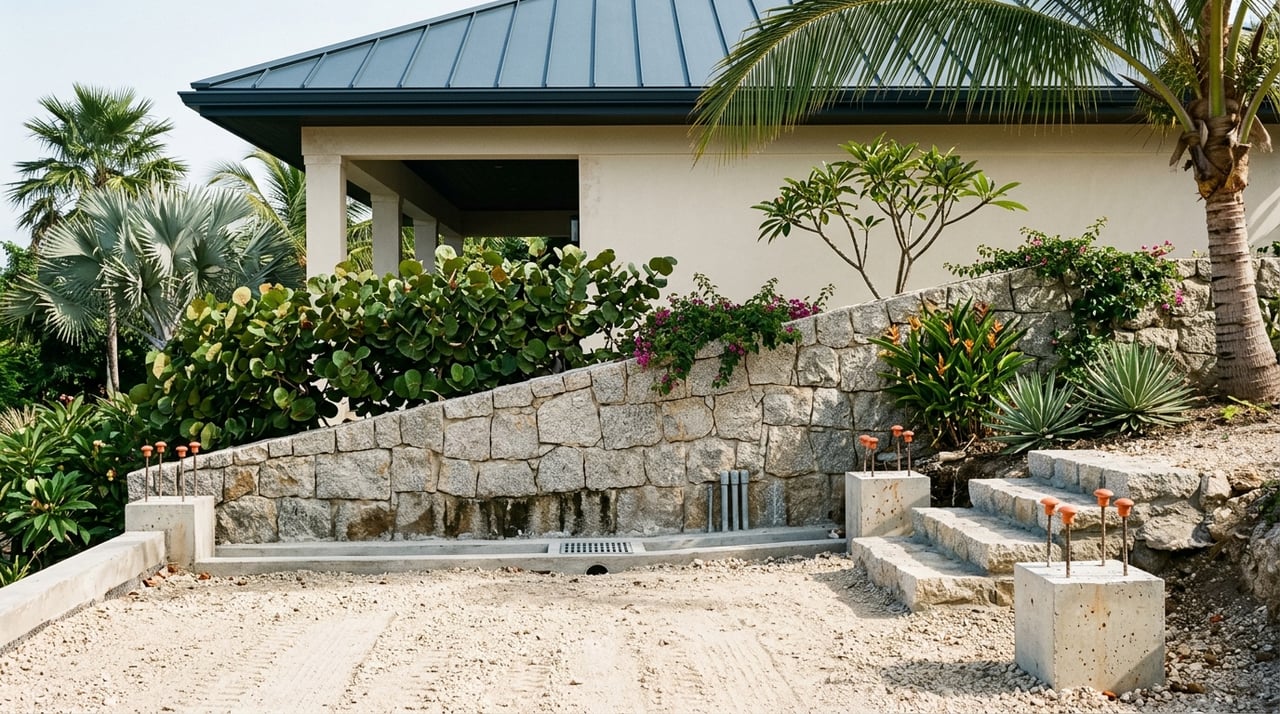
A beautiful hillside parcel may also require more work than you expect. On steeper or higher sites, driveway design, drainage, and retaining walls can become central parts of the planning process. On Jost Van Dyke, buildability is often tied as much to slope and access as it is to the view.
Why topography matters early
If you wait too long to study the site, your concept design may need major changes later. A parcel that looks straightforward on paper can present practical issues once road access, gradients, and building platforms are reviewed. Early feasibility work helps you avoid designing a home that is harder or more expensive to deliver than expected.
This is especially important on an island where access points and road geometry are regulated. If standard access is impractical because of the gradient, alternative layouts may need to be considered. That is why site review should come before you get attached to a final vision.
Confirm Title and Land Records
Before you commit to a build, order a Land Registry search. In the BVI, the Land Registry is the repository for registered land transactions, and a search can reveal easements, restrictions, cautions, and other incumbrances. Searches are immediate, while certified copies take two working days.
This step matters because title issues can directly affect what you can build and how you can access the site. A parcel may have an easement across it, a restriction that affects use, or another recorded matter that influences value and development potential. It is much better to learn that before design work moves forward.
When a certified copy is needed
For residential development, TCPD requires a certified copy of the Land Register as part of the planning submission. That means even if you begin with a standard search for early due diligence, you may still need the certified copy for the application package. Building with a clean file from the start can save time once approvals begin.
Bring in a Surveyor Early
If there is any uncertainty about boundaries, access, or easements, involve a licensed surveyor as early as possible. The Land and Survey Department handles boundary investigations and cadastral data, and the Land Surveyors’ Board regulates surveyors in the Territory. On a site with irregular terrain or unclear access, this is not a step to leave until later.
A survey can help confirm whether the parcel matches your assumptions on paper and on the ground. It can also clarify where you can realistically place structures, roads, and utility runs. If you are considering a more complex homesite, early surveying can be one of the most valuable parts of your due diligence.
Where technical advice adds value
The research also notes that RICS-qualified surveying input is locally relevant for technical and feasibility work. On a parcel where slope, retaining walls, access, and utility extensions could materially change the budget, technical review before final land commitment is a smart move. For luxury homes and villas, this kind of analysis can protect both design quality and financial clarity.
Check Access, Power, and Water
Utilities should be confirmed before you fix your design. The government announced that Jost Van Dyke was reconnected to the BVIEC grid in February 2024, and a 2023 notice said water on JVD was rationed because of an extensive power outage. The practical takeaway is simple: verify both continuity and backup capacity for power and water before you commit.
That means asking not only whether service is available, but also how dependable it is for your planned use. If you are building a villa with higher utility demands, resilience planning becomes part of the design conversation. Island building works best when infrastructure questions are answered early, not after construction begins.
On-site systems still matter
The 1972 Land Development Control Guidelines require rainwater catchment and storage for habitable buildings. They also require septic-based wastewater disposal unless a public sewer is available. In practical terms, your design may need to account for cistern capacity, wastewater systems, and related site-civil work from day one.
The same fee schedule separately references cisterns, retaining walls, jetties, and roads. That is a useful reminder that a build on Jost Van Dyke may involve much more than the home itself. Site infrastructure can be a meaningful part of both approvals and budget.
Review Coastal and Environmental Constraints
On Jost Van Dyke, resilience should be treated as a design input, not a finishing touch. The Virgin Islands sits in the hurricane belt and is highly vulnerable to climate impacts, including more extreme rainfall and flooding, drought, coral bleaching, and sargassum events. Hurricane exposure and water management should be part of your thinking from the beginning.
If your lot is near the shoreline or in another sensitive area, due diligence becomes even more important. Under the Physical Planning Act, environmental impact assessment is required for developments in Schedule 3 and can also be required where significant adverse environmental impact could result. Coastal zone developments, wetlands, marine parks, national parks, conservation areas, and environmental protection areas receive special concern.
Why coastal parcels need extra review
If the project touches the shoreline, the 1972 guidelines call for professional reporting on site conditions, ecology, hydrogeology, water transport, maps, photographs, topographic charts, submerged-land contours, and a completion report. Waterfront and other setback rules also apply, so the distance from the high-water mark should be checked before design work begins.
In addition, the Physical Planning Act allows refusal where land is unsuitable because of flooding or subsidence. For coastal or bluff-edge sites, early input from environmental and civil professionals can help you identify risks before they affect your budget or approval path. On high-value island land, that kind of clarity is worth having upfront.
Understand the Approval Process
On Jost Van Dyke, planning permission and building permits are separate processes. You cannot skip planning and go straight to building. Both steps can require revised drawings and supporting documents, so it helps to treat approvals as a structured sequence rather than a quick formality.
TCPD operates under the Physical Planning Act 2004 and the 1972 guidelines. For residential development, the current workflow requires triplicate application forms and drawings, a certified copy of the Land Register, proof of Belonger status or a Non-Belonger Land Holding Licence, lease documents where relevant, and a notarized certificate of non-objection if the applicant is not the landowner or shares ownership.
Building permit details to know
The Public Works process also requires drawings in triplicate. The stated application fee is $75, approvals are usually turned around in up to four weeks, inspections are $25 each plus $150 for final inspection, and 48 hours’ notice is required on the Sister Islands. Any changes to approved drawings must be reapproved.
That last point is especially important on custom island projects. If you revise layouts, foundations, or structural elements during the process, those changes may need formal approval before work continues. Clear drawings and the right team can help reduce avoidable delays.
Factor in Non-Belonger Requirements
If you are a Non-Belonger and want to lease or purchase property for development, you will need a Land Holding Licence. According to the service page, applications move from the Ministry to Cabinet and then registration. The fee is $200 for an individual or $500 for a company, and the stated turnaround is 8 to 12 weeks.
This timing matters because it can affect your purchase and development schedule. If your project depends on licensing, you will want that requirement built into your planning from the start. On a time-sensitive acquisition, early preparation can make the process smoother.
Prepare for Closing Costs and Timing
Stamp duty is a separate closing step. Current guidance distinguishes Belonger and Non-Belonger transfer rates and requires supporting documents such as a recent appraisal, purchase and sale agreement, and land-holding licence where applicable. Instruments should be stamped within 30 days of execution.
For buyers handling matters from Jost Van Dyke, Inland Revenue also lists monthly district office hours in Great Harbour. That may help with island-based processing. Even so, it is wise to organize your closing documents early so the post-contract timeline stays on track.
Build the Right Professional Team
A smooth project usually starts with the right sequence of professionals. A licensed surveyor should be brought in early, especially if boundaries, access, easements, or topography are unclear. An architect or qualified designer should also be engaged before filing because TCPD requires scaled, legible, signed drawings and does not accept sketches.
On more complex sites, technical advisory can be just as important as design. Where slope, access, retaining walls, and utility extensions can materially change the budget, early feasibility input helps you make better decisions before final land commitment. For many buyers, that can be the difference between a vision that works on paper and one that works in practice.
A practical due diligence sequence
The cleanest sequence on Jost Van Dyke is:
- Search title and obtain the relevant Land Registry records.
- Survey the parcel if there is any uncertainty.
- Confirm access and utility feasibility.
- Screen for environmental and coastal constraints.
- Prepare planning and building applications with the right professionals.
Following this order can help you identify issues early, protect your budget, and move into design with fewer surprises.
If you are evaluating a homesite or planning a villa build on Jost Van Dyke, careful due diligence can save time, reduce risk, and help you shape a project that fits both the land and the approval process. For tailored guidance on BVI land, luxury homesites, and technically complex island transactions, connect with Christies BVI Residential.
FAQs
What due diligence should you do before building on Jost Van Dyke?
- Start with a Land Registry search, confirm boundaries and access with a licensed surveyor if needed, review utility feasibility, check for environmental or coastal constraints, and then prepare planning and building submissions in the proper order.
Do you need planning permission before a building permit in the BVI?
- Yes. Planning permission and building permits are separate processes, and you cannot skip planning and go straight to building.
Do you need a survey for a Jost Van Dyke homesite?
- Usually yes if there is any uncertainty about boundaries, easements, access, or topography, since those issues can affect both title review and practical buildability.
What utility issues should you check on Jost Van Dyke before building?
- You should verify power availability, backup capacity, water continuity, rainwater catchment requirements, and septic needs before finalizing your design.
What happens if your Jost Van Dyke lot is coastal?
- Coastal sites can face setback rules, added documentation requirements, and possible environmental impact assessment depending on the project and location.
Do Non-Belongers need a land holding licence to build in the BVI?
- Yes, if a Non-Belonger wants to lease or purchase property for development, a Land Holding Licence is required under the current process.
How long does a BVI building permit usually take?
- The stated Public Works turnaround is usually up to four weeks, assuming the submission is complete and any required revisions are handled properly.